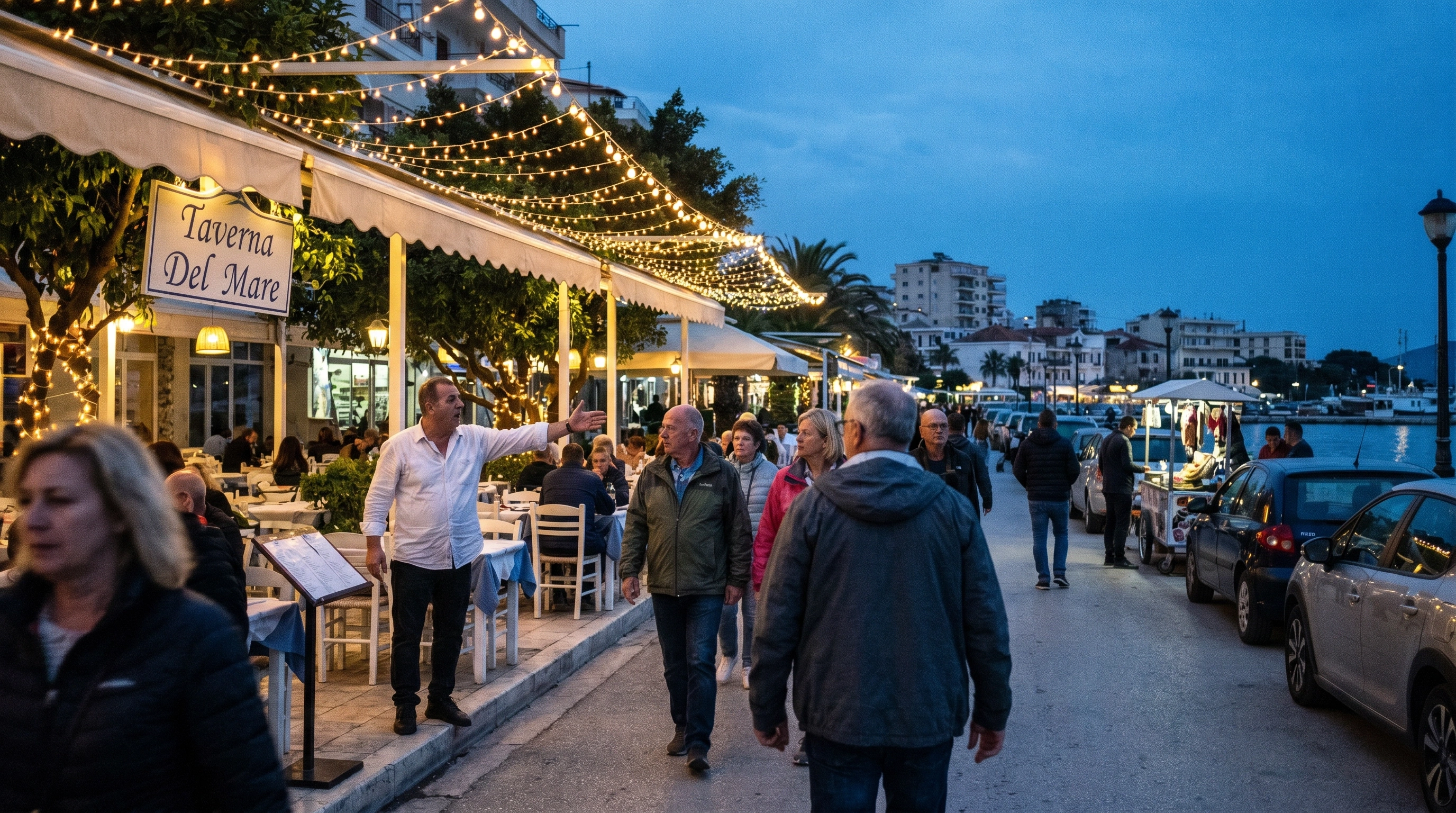
Red flag #1: The waiter is on the street pulling people in
A restaurant that is genuinely good — the kind of place where the seafood is fresh and the locals come back — does not need someone on the pavement calling out to passersby. It is full because word got around, or because the regulars showed up, or because someone asked a local and got the right answer.
When a waiter is aggressively gesturing from the doorway at every tourist who walks past, it is because the restaurant needs volume to be profitable. Volume means speed. Speed means shortcuts. Shortcuts in a seafood restaurant almost always mean fish that was not bought this morning.
The restaurants on the Sarandë promenade that do this are often not bad places to sit. But they are built for throughput, not for the best fish available today. There is a difference, and it shows up on the plate.
Red flag #2: The menu has photos of the food
Photos on a menu are a signal, not a verdict. But in the context of a seafood restaurant in a tourist town, they usually mean one thing: the restaurant is selling an image rather than a product.
A restaurant that is confident in its seafood does not need a photograph of a grilled sea bream. The fish sells itself. A restaurant that is trying to justify a €22 price for something it bought two days ago at wholesale for €3 needs the photo to do the convincing first.
More practically: menu photos are almost always stock images or are taken in the best possible conditions. They bear no relationship to what arrives on your table. A counter at a fish shop has no photos — just the fish itself, fresh, on ice, right in front of you.
Red flag #3: The "fresh catch of the day" is the same every day
Actual daily catch varies. Some days the boats come in loaded with sea bream and barbun. Other days the best catch is octopus or calamari. What's fresh on a Tuesday in July is not identical to what's fresh on a Thursday in August.
If you visit a restaurant three days in a row and the "daily special" or "catch of the day" is always sea bream with lemon and chips, they are not running a daily specials board based on what came in from local boats. They are running a permanent item with a rotating name. That is not a crime, but it is not honesty either.
Ask this before ordering: "What fish came in this morning specifically?" If the answer is vague, generic, or the same answer you got yesterday at a different restaurant, trust your instincts.
Red flag #4: The seafood menu is impossibly long
A legitimate fresh fish restaurant in a coastal Albanian town, sourcing from local boats, can realistically offer 6–10 species on a good day. Sea bream, sea bass, red mullet, octopus, calamari, shrimp, mussels, maybe sardines or anchovies. That is a realistic daily counter.
When a menu offers 25 seafood dishes including "lobster," "king prawn," "swordfish steak," "salmon fillet," and "tuna carpaccio," none of those last five are local. Most are frozen and imported. There is nothing wrong with that if the restaurant discloses it — but they rarely do, and they often charge as if every item came off a Sarandë fishing boat that morning.
Short menus in seafood restaurants are a good sign. They mean the chef bought what was fresh today and is working with it, not reaching into a freezer for whatever a supplier sent last week.
Red flag #5: The price is suspiciously high and the explanation is vague
High prices alone are not a red flag — good fish in a beautiful setting costs something. But when you ask why the sea bream is €24 and the answer is "it's very fresh" or "local catch" without any specifics about what came in today, when, from which boat — that vagueness is worth noticing.
Honest fish vendors can tell you exactly what arrived and roughly when because they bought it themselves or watched the delivery happen. The specificity is the credibility. "This morning's catch, came in at 6:30, I bought the whole lot from the Alidemaj boat" is something you might hear at a fish shop. "Very fresh, local" is a restaurant phrase.
The alternative most locals use
Rather than running a checklist every time you want seafood, there is a simpler approach: go where you can see the fish before it gets cooked. A fish counter puts the product in front of you. Nothing is hidden behind a menu description or a promotional photo. You pick the fish, agree on the price by weight, and know exactly what you're getting.
For people staying in Sarandë or Ksamil with any access to a kitchen or grill, this is not a workaround — it is simply the way Sarandëans have always eaten seafood.
Skip the guessing — see the fish yourself
Rruga Idriz Alidhima 230, Sarandë · Open every day 8:30 AM – 10:00 PM
Frequently Asked Questions
How do you avoid tourist traps in Saranda?
Look for restaurants away from the main promenade strip, with short menus focused on 6–10 species, no aggressive door service, and the willingness to tell you exactly what came in today. Better still, buy from a fish counter directly — you see the fish, choose it yourself, and there's nothing to be misled about.
Are seafood restaurants in Saranda expensive?
Tourist-facing promenade restaurants typically charge €18–28 for a grilled whole fish. That is 4–6x the raw ingredient cost at the fish counter. Restaurants serving locals (further from the waterfront, Albanian menus, no English signs) are significantly cheaper and often better quality.
What is the best way to eat fresh fish in Saranda?
Buy it from a fish shop in the morning, have it cleaned there, and cook it yourself at your accommodation. If you're not cooking, look for small family-run restaurants where the owner is also the buyer — someone who can tell you exactly where the fish is from today.